
“Use it up, wear it out, make it do, or do without”
E-Waste
The term “electronic waste” or “E-waste” elucidates discarded electronic devices, which are destined for reuse, resale, salvage, recycling or disposal. A general insight into the electronic waste generation cycle will make us realize the fact that this is an alarming problem, which needs to be addressed as soon as possible, on a global scale.

This chart shows the exponential growth of electronic waste generation in an under-developed nation, which is expected to reach about 1.8 million tonnes by the year 2025. If this seems alarming to you, then the fact that India alone produced a whopping 1.7 million tonnes of e-waste in the year 2014 alone, may come as a shock to you. Ranking 5th on the list, made by UN, of highest e-waste generators, India’s maximum e-waste comprised of household equipment.
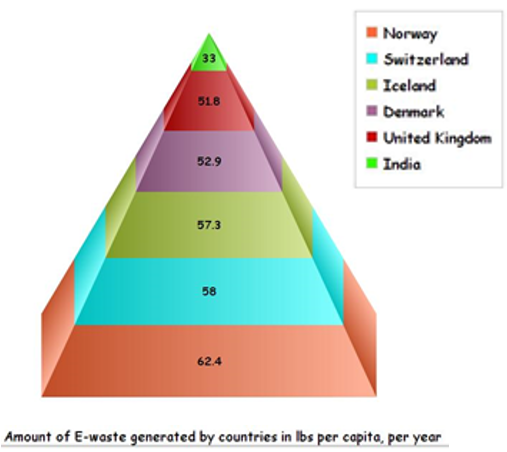
In terms of per capita waste generation, India’s reports are less alarming (not in top 10 ranks), but the high rate of the population becomes the actual threat. This problem needs to be tackled as soon as possible and in an effective manner, as it possesses a high level of threat to the health of the community and the environment.
How to tackle the E-waste problem…???
And this is what my project is actually about:
A digital LED display from disposed of decorative lightings.
I have used some damaged decorative lights and used its LED lights and its wire. I have also used a cardboard and an A4 size paper. These LEDs are arranged in a seven segment display, which is used to display any numeric value. This is done by creating a tube-like structure using rolled pieces of paper, which is placed systematically on the LEDs in a way that when a specific LED glows, it seems as if the entire segment is glowing. This display can be used to design a stop-watch, a digital clock in public areas or even a calculator’s display.


This project of mine is aimed at making everyone realize that even an unused/damaged decorative light can be used to make such a useful display that can be integrated into almost any latest electronics device/projects. Then consider the possibilities that can arise from all the e-waste that is generated all year round
I would like to conclude by just noting down that electronic waste that is considered as a global threat and generates pollution can be used in an effective manner to even generate revenue and even increase the scope of employment, thus giving a new edge to the e-waste industry.
Comments
Post a Comment